
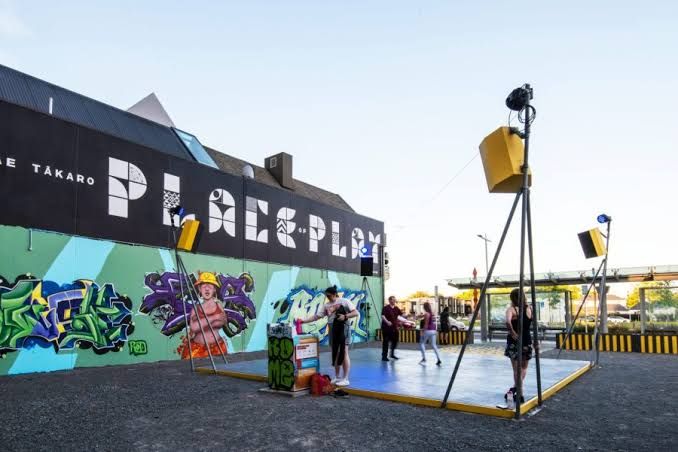
At dinner last night after an AANZPA Executive meeting, Simon from Christchurch shared stories about a local initiative called Gap Filler – a creative urban regeneration social enterprise that emerged after the devastating earthquakes in Ōtautahi Christchurch.
I found myself deeply moved listening to him speak.
Not because everything succeeded. In fact, he said many experiments failed.
But because there was permission to experiment in the first place.
There was space for communities to try things. To prototype. To gather. To activate empty spaces. To test ideas. To create life in the gaps left behind by disaster.
And something about that stayed with me.
Gap Filler began after the 2010 and 2011 earthquakes, when large parts of Christchurch’s city centre were left damaged, empty, uncertain, and emotionally devastated. Friends Ryan Reynolds, Coralie Winn and Andrew Just started organising grassroots community events and temporary activations in vacant sites to help bring people back into relationship with the city and with each other. What started as small acts of creativity evolved into an internationally recognised placemaking and urban regeneration movement.
What I find inspiring is not simply the creativity of the projects themselves – though projects like the famous Dance-O-Mat, outdoor cinemas, pallet pavilions, giant arcade games and temporary gathering spaces are brilliant examples of playful civic imagination.
It is the philosophy underneath them.
The belief that communities should not just be consulted about the future of their city – but actively participate in shaping it.
The belief that small experiments matter.
The belief that temporary projects can create permanent shifts in culture.
The belief that local people carry imagination, knowledge and leadership that institutions alone cannot generate.
Gap Filler described their work as operating “at the crossroads of community development, urban design, art and public intervention” and creating conditions for “experimental and playful encounters to connect people to place.”
That language resonates strongly with me because much of my own work through Soulgen sits in a similar territory – the space between participation, community development, social cohesion, creativity and place-based leadership.
And yet, listening to Simon, I also found myself reflecting on how rare these kinds of ecosystems still are in Australia.
We often speak the language of participation, co-design, and place-based work. But in practice, many systems remain heavily driven by:
short funding cycles
predefined outcomes
risk management
program logic frameworks
measurable impact metrics
organisational KPIs
transactional engagement processes
None of these things are inherently bad. Accountability matters.
But real community life rarely unfolds in a linear way.
Trust takes time.
Participation is messy.
Leadership emerges unevenly.
Relationships cannot always be quantified.
And some of the most important outcomes are intangible:
belonging
confidence
connection
stewardship
civic imagination
local ownership
willingness to contribute
Sometimes projects fail too.
But failure is not always failure.
Sometimes a failed community experiment still builds relationships, confidence and learning that shape future initiatives years later.
What struck me about the Christchurch story was that the city, through necessity and crisis, created openings for a different kind of civic culture to emerge.
Vacant spaces became opportunities.
Temporary became powerful.
Citizens became active co-creators of the city itself.
Gap Filler eventually moved from grassroots experimentation into broader partnerships with councils, developers and urban regeneration processes, helping influence how participation and placemaking were understood at a larger scale.
To me, this points toward something important:
ABCD and place-based work are not simply about activating communities.
For that activation to truly flourish, systems themselves also need to evolve.
Communities need:
hubs
connectors
local stewardship
flexible micro-funding
relational infrastructure
permission to experiment
long-term support for participation cultures to emerge
Without this, community energy can remain at the edges – inspiring, but disconnected from wider systems change.
And perhaps this is why I increasingly find myself interested not only in facilitation or engagement itself, but in the deeper question of how we create the conditions for participation, belonging and shared ownership to genuinely take root in place.
Not through control.
Not through top-down planning alone.
But through relationships, experimentation, imagination and trust.
Christchurch reminds us that cities are not only built through infrastructure.
They are built through participation.
Through collective creativity.
Through people slowly re-learning that they have agency in shaping the places they live.
And maybe, in a time where loneliness, fragmentation, and institutional fatigue are rising everywhere, this kind of work matters more than ever.
Perhaps part of the challenge ahead is not simply designing better programs – but growing stronger participation cultures, relationships, and stewardship in place.
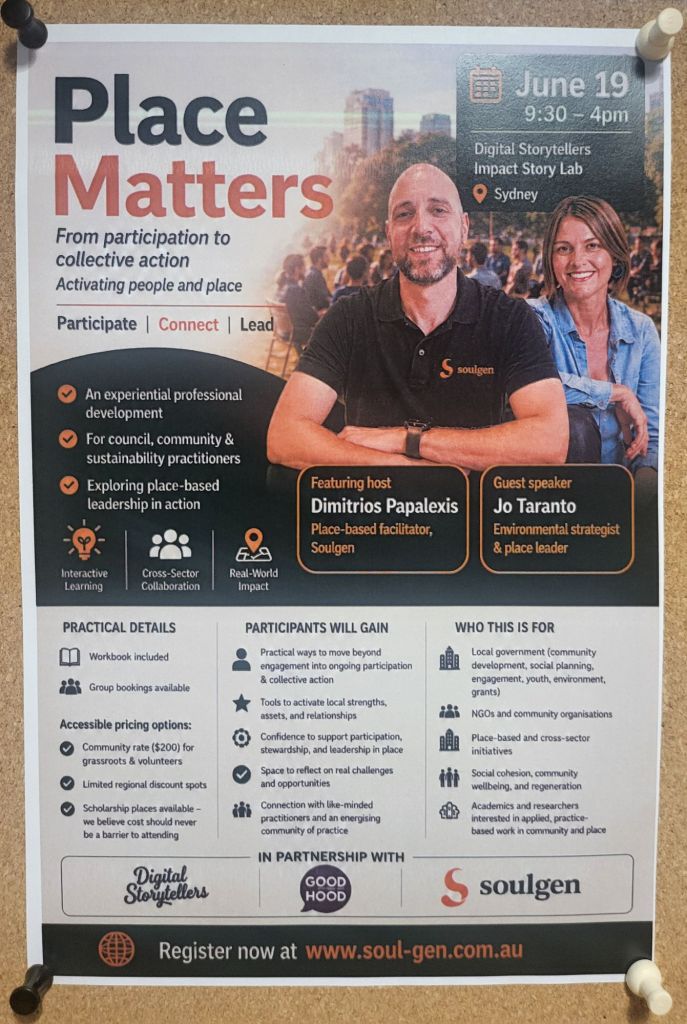
These are some of the themes I’ll be continuing to explore through this June in Sydney, alongside practitioners, community leaders and people interested in the future of place-based and participatory work.
Learn more about Place Matters
 Soulgen
Leave a comment