

In a recent article, I explored place-based leadership as the practice that brings a place to life.
By place-based work, I mean approaches that start with a particular community or locality – its people, relationships, strengths, history, challenges and possibilities – and bring people together to respond in ways that are grounded in that place and its people.
By place-based leadership, I mean helping create the conditions for people, organisations and systems to work with a place, not just in it – so that participation can grow into stewardship, shared ownership and sometimes shared leadership.
But another question often follows:
How do we sustain this work over time?
Because many place-based efforts do not fail from lack of good intentions. They struggle because the early energy fades, relationships weaken, key people move on, or systems slip back into familiar habits.
Sustainability is not just about funding. It is about how the work is held, shared and grown within a place.
What this can look like in practice
One of the challenges with place-based work is that it can sound abstract. So what does it actually look like?
It can take many forms:
- a community of practice connecting stakeholders
- a cross-sector group bringing together council, schools, services, residents and local leaders
- a partnership or collective impact initiative
- a place-based working group or steering group
- a network of neighbourhood connectors, community champions or local leaders
The label matters less than the way of working.
What matters is who is included, how power is shared, whether trust is built, whether community leadership is real and whether systems adapt to the place and its priorities.
Often this kind of work needs:
- someone to convene across different stakeholders
- support to build shared language and trust
- reflective practice, so people can learn as they go
- enough space for participation to grow into stewardship and leadership
Sometimes that role sits within council or a partner organisation. Sometimes an external facilitator, intermediary or backbone support can help hold the space, build capacity and support collaboration.
The funding might come from community development, social cohesion, philanthropy, government grants, sponsorship or existing programs reorganised in a more place-based way.
But the deeper shift is not just where the money comes from. It is how the work is organised and held.
From collective impact to collective ownership
There is growing interest in collective impact and cross-sector collaboration. These approaches can be useful. They can align people, create focus and build momentum.
But they can also become too top-down if they are driven mainly by institutions and not meaningfully shaped by community.
A strengths-based approach asks different questions:
- What is already working here
- What do people care about?
- What are the hopes and aspirations already present in this place?
- What strengths, skills and resources already exist?
- Who is already acting, contributing or quietly holding things together?
I remember Aunty Robyn in Villawood saying something that has stayed with me: don’t ask people what they need – ask what they have to offer, and support them to bring it.
That is a profound shift.
It moves the work
- from fixing problems to building on strengths
- from coordinating services to activating relationships, local leadership and community capacity
It also changes the role of institutions. Instead of always leading from the front, they may need to lead more from the side – enabling, resourcing, backing local action and learning to work with communities rather than doing things for them or to them.
Participation at the centre
This is where many collaborative initiatives succeed or fail.
It is not enough to invite the community in once the script has already been written. Consultation can sound inclusive while power, decisions and shared action still sit elsewhere.

If community is not meaningfully engaged, people can become the objects of change – passive recipients of plans made by others – rather than the subjects of change, shaping and leading what happens.
A stronger approach asks that:
- community engagement begins early
- those most affected are in positions of influence
- professionals step back enough to create space for community hopes, voice and action
- agencies and councils also build their own capacity to work in more participatory ways
This kind of work moves at the speed of trust.
And trust is not built through documents alone. It is built through relationships, repeated contact, honest conversations and small acts of follow-through.
From management to movement
Traditional collaboration often focuses on coordination:
aligning services, improving systems, and sharing information
That has value. But on its own, it rarely creates deeper change.
Sometimes what is needed is closer to movement-building:
bringing together diverse voices, creating shared aspirations,
helping people imagine what is possible, and
building the energy and relationships that make collective action more likely
This is where place-based leadership comes alive.
Not as control.
Not as one heroic leader.
But as the practice of creating the conditions for change to emerge.
I saw this years ago in Woolloomooloo. Working alongside Hope Street and a broad mix of local leaders, residents, services, schools, council and others, we used asset mapping and strengths-based facilitation to build relationships and uncover what people cared enough about to act on. Out of that came collaborative and creative initiatives – greening projects, community-led festivals, long table meals, listening projects and other local activations.
What mattered was not just the projects themselves, but the relationships and sense of shared possibility underneath them.
Working with complexity, not against it
Place-based work sits inside real-world systems:
- short-term funding
- competitive tendering
- pressure for quick results
- institutional habits that favour control
- a tendency to value what is easy to measure over what actually matters

These conditions can make relational, strengths-based work harder. But they also make it more necessary.
To sustain this work, we need:
deep connection to local context, time to build relationships and trust, support for practitioners and institutions to work differently,
a balance between long-term process and small visible wins, and
an equity lens, so diverse voices are included and empowered
I have seen how simple methods can help this happen.
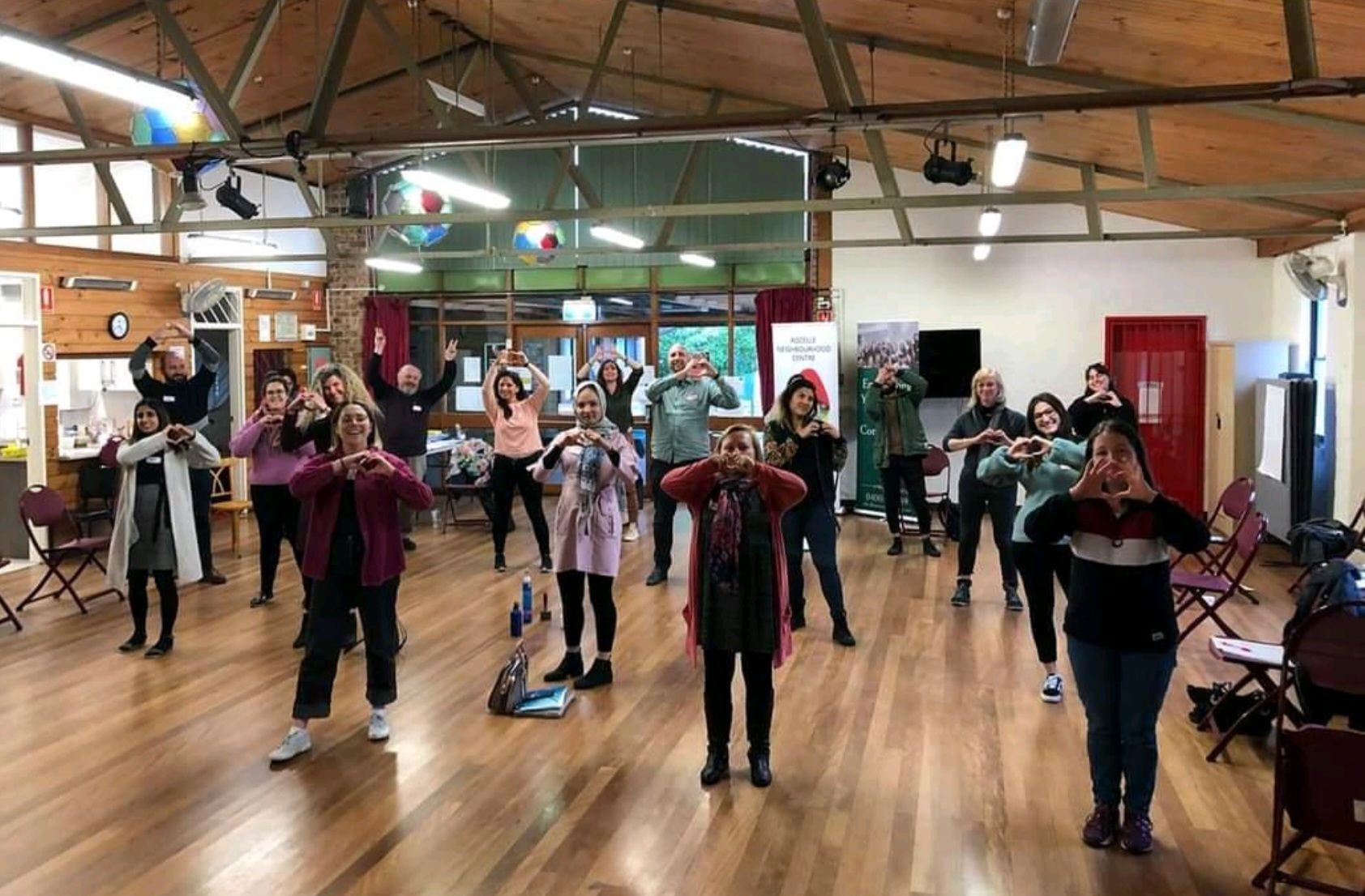
In Morisset, using images, games and embodied activities helped people connect more deeply and speak honestly about community aspirations and what needed to be left behind. People said they learned more about each other in that session than in months of working alongside one another.
In Deniliquin, a community of practice created room for reflection, connection and shared action across organisations.
In Cooks River Changemakers, relational and sociometric methods helped build trust and stewardship around place.
In Villawood, community-led activity helped shift the story of postcode 2163 through gatherings, enterprise ideas, shared meals and neighbourhood participation.
In Mount Druitt, spaces like the Hive have shown the value of creating places where collaboration and belonging can grow.
These are different contexts, but they share something important: they invest in relationships, trust and local capacity.
The groan zone
This work is rarely smooth.
There will be moments of:
confusion, tension, repetition, uncertainty, frustration, and
even hopelessness
This is not necessarily a sign that something is wrong.
Sometimes it is what design theory calls the groan zone – the uncomfortable space between divergence and convergence where real learning, change and innovation can happen.
Staying with that phase is part of the work.
Sustaining the work
So what helps sustain place-based work over time?
- ongoing convening, not one-off engagement
- trust-building and relational infrastructure
- shared language across sectors
- distributed leadership
- reflective practice
- flexibility and responsiveness to the place
- institutions learning how to enable, not just manage

And importantly, recognising that this is not linear work.
There will be:
divergence, emergence, including the groan zone, and
convergence
Sustainability comes from staying with the work through these phases – and from building the relationships, structures and habits that help a place keep going beyond the first burst of energy.
It also means valuing the people who can hold this kind of space well – facilitators, connectors, convenors and local leaders who can navigate relationships, support difficult conversations, and help trust grow across differences.
An invitation
If this resonates, and you work in community, local government or across sectors, this is exactly what we’ll be exploring in more depth in an upcoming training:
Place Matters: From Participation to Shared Leadership – Activating People and Place in Practice

This is not a conference or a panel.
It is a practical, experiential space to:
- explore place-based and strengths-based approaches
- deepen understanding of participation, stewardship and shared leadership
- learn alongside others working in similar contexts
- engage with the real dynamics that shape this work
You do not need to have all the answers to begin.
But you do need a place to start – and others to walk alongside.
Leave a Reply