
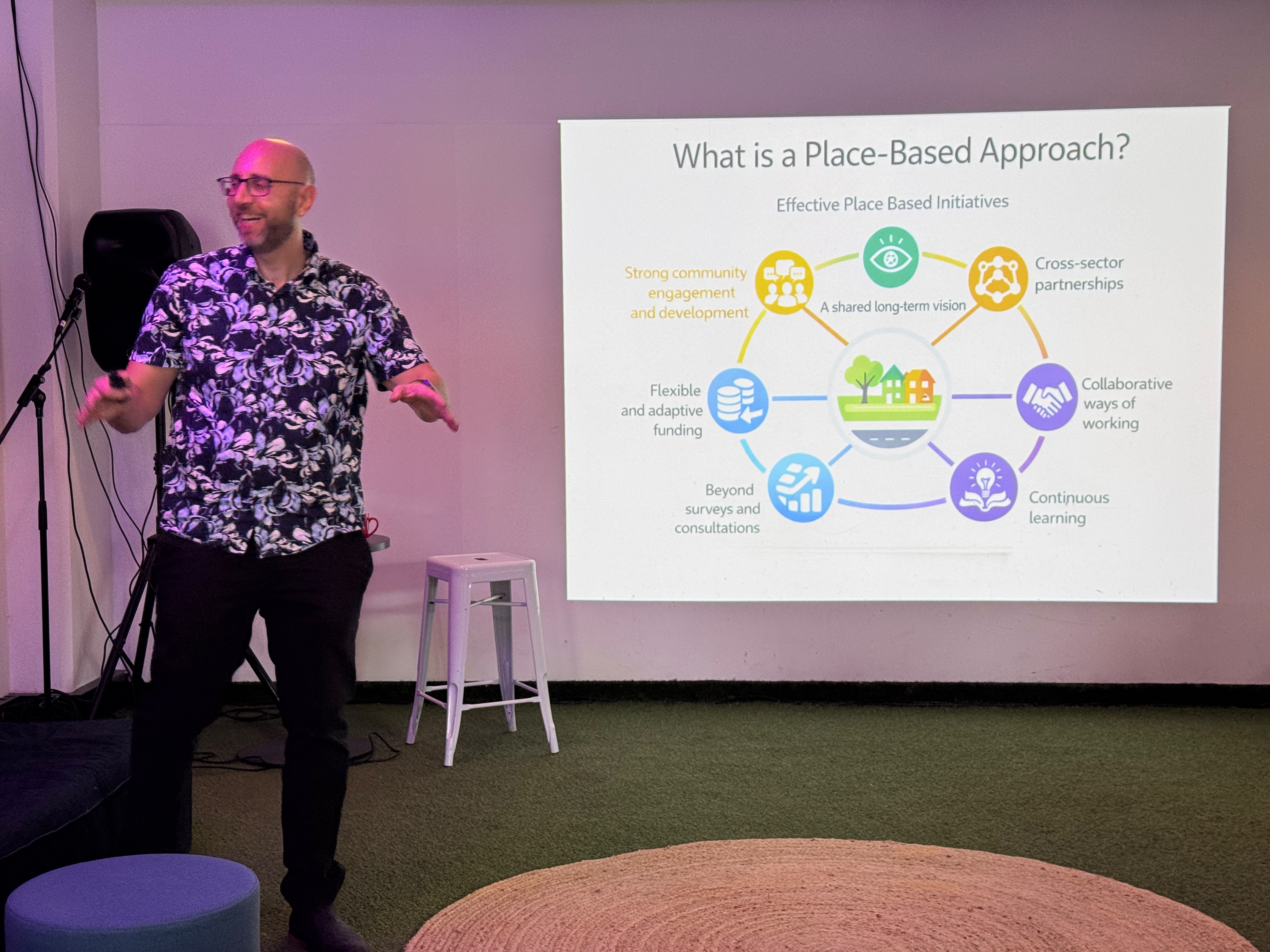

The more I do this work, the more I have come to see myself as a facilitator.
A facilitator of people, teams, and communities through participatory, strengths-based, and relational processes.
This week, as I train another group of Camp Venture facilitators – and as I prepare to head to Geelong for the Australasian Institute of Facilitation conference – I’ve found myself thinking more deeply about that word.
Facilitator.
It has increasingly become part of my professional identity.
But what does it actually mean to me?
I didn’t begin my career by deciding I was going to become a professional facilitator. In many ways, I found my way into facilitation intuitively – through community development, youth work, counselling, group work and a curiosity about what happens when we create the right conditions for people to connect, participate, imagine and act together.
Over the years, I became more intentional about the craft.
I trained, studied, and experimented with approaches such as the Art of Hosting, World Café, Circle Practice, Open Space Technology, Appreciative Inquiry, Asset-Based Community Development, psychodrama, sociometry and other participatory practices.
I collected methods.
I learned frameworks.
I filled my metaphorical – and sometimes very literal – facilitator’s toolbox.
And all of that matters.
But lately, I’ve felt a need to dig deeper.
Beyond the methods, tools, and techniques – what kind of facilitator do I actually want to be?
Perhaps this is an important question for our times.
We live and work in increasingly complex environments. Communities are navigating fragmentation, loneliness, and polarisation. Organisations operate across silos. People are asked to participate in consultations while sometimes wondering whether anybody is really listening.
We need people who can create spaces where different voices can meet.
Where people can listen across difference.
Where strengths and possibilities can emerge alongside problems.
Where relationships can form.
Where people don’t simply participate in somebody else’s agenda but have the opportunity to shape what happens next.
Facilitation, I believe, is part of the work of our times.
And being Greek, when I want to understand something more deeply, I often find myself going back to language.
So I became curious:
How do we say “facilitator” in Greek?
There isn’t just one interesting answer.
Διευκολυντής – the one who makes things easier
Διευκολυντής comes from διευκολύνω – to facilitate, to make something easier.
Interestingly, the English word facilitate carries a similar idea through the Latin facilis – easy.
But making things easier doesn’t mean doing the work for people.
For me, it means removing barriers and creating conditions where participation becomes possible.
Making it easier for someone to speak.
Easier for another perspective to enter the room.
Easier for people to discover what they already have.
Easier for a group to move from conversation towards collective action.
Perhaps the facilitator doesn’t carry people across the river.
Perhaps we help them discover where the stepping stones are.
Συντονιστής – the one who helps us come into tune
Another common Greek word is συντονιστής.
It carries the idea of coordination – bringing things into alignment, synchronisation, or tune.
I love thinking about this musically.
A group contains many voices.
Different experiences. Different rhythms. Different volumes. Different ways of seeing the world.
Our job isn’t to make everybody sing the same note.
Good facilitation isn’t manufactured agreement.
Perhaps our role is to help people hear one another well enough that something new can emerge from their differences.
To help the room come into tune without removing the uniqueness of each voice.
And then there is my favourite.
Εμψυχωτής – the one who brings life
Εμψυχωτής comes from εμψυχώνω – to animate, encourage, inspire, to bring life or spirit.
And at its heart is a beautiful Greek word:
ψυχή – psyche – soul.
This one stopped me.
Because perhaps this gets closer to the kind of facilitator I aspire to be.
Not the expert who arrives carrying all the answers.
Not simply the technician with a suitcase full of clever methods.
But someone who helps bring a group to life.
Someone who notices energy.
Who helps people discover gifts they may have forgotten they carry.
Who creates enough safety, playfulness, and possibility for spontaneity to emerge.
Who helps relationships come alive.
Who trusts that there is already wisdom, creativity, and capacity in the room – and that our work is often to create the conditions for it to become visible.
Perhaps it’s no accident that many years ago I called my work Soulgen.
Soul. Generation.
A hope, in some small way, to contribute towards a more soulful generation.
Perhaps my understanding of facilitation has been moving in that direction all along.
So here’s the question I’m sitting with:
Beyond your qualifications, methods, frameworks, and facilitator’s toolkit , what kind of facilitator are you?
What is your deeper expression of the role?
What comes naturally to you?
What do people experience when you host a room that they might not experience in quite the same way with somebody else?
Maybe you’re a connector.
A storyteller.
A challenger.
A listener.
A playful provocateur.
A sense-maker.
A bridge-builder.
Someone who makes things easier.
Someone who brings different voices into tune.
Someone who brings things to life.
That deeper expression may be more than your facilitation style.
It may be part of your gift.
And perhaps even part of your unique contribution to the world.
Ultimately, techniques can be learned. Frameworks can be taught. Methods can be copied.
But the deeper work is learning how to embody our practice.
The more we understand what we uniquely bring – and the more courageously we inhabit it – the less we depend on techniques and tricks to make something happen.
The method still matters.
But so does the human being holding the space.
So, to my fellow facilitators:
What kind of facilitator do you want to be?
And beneath all the methods and professional language –
What brings your facilitation to life?
Leave a Reply