

What a walk through Parramatta reminded me about moving beyond identifying assets to connecting and mobilising them – and bringing places to life.
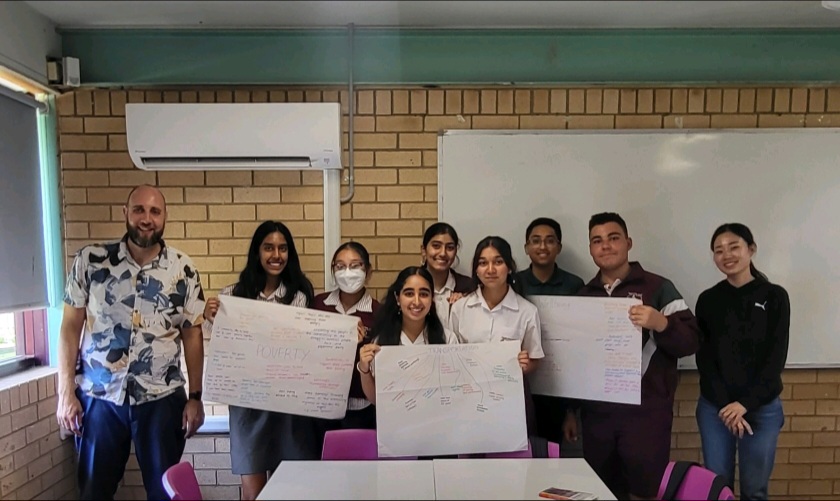
At a recent workshop with Cormac Russell, hosted by Resourcing Inclusive Communities in Parramatta, we were invited to do something very simple.
Leave the room.
Walk through the neighbourhood.
And notice the assets around us.
Simple, perhaps. But not necessarily easy.
It asks us to slow down, be present and look at a place through a different lens.
When we returned to the room, there were so many observations and contributions. The exercise made asset mapping real, current and place-based. It reminded me that a place is never simply a collection of buildings, services or infrastructure. It is alive with people, relationships, histories, cultures, institutions, natural spaces, informal meeting places, gifts and possibilities.
But as I walked, something else happened.
I found myself not only identifying assets, but remembering stories of what can happen when we connect and mobilise them.
Children in the square
Walking through Parramatta Square, I noticed the extraordinary diversity of people and cultures around me.
Old and new sitting alongside each other. Technology integrated into public space. Restaurants full of people meeting, eating and taking a break from work. Even a robot cleaning the square with a cheerful “hello”.
But one of the simplest things caught my attention.
Children playing in the water near the cathedral.
Shirtless, running around, making noise, occupying public space and having fun.
It warmed my heart.
Perhaps because it reminded me of my own childhood growing up in Volos, Greece – playing marbles in the neighbourhood, hide-and-seek in the streets and exploring by the river until my yiayia called my name from the veranda to come home and eat a sandwich – usually with lots of garlic.
We didn’t call it community development.
We were simply children inhabiting our neighbourhood.
Playing. Exploring. Making friends. Creating our own adventures.
And standing in Parramatta watching those children play, I found myself thinking:
What if children and young people are among the greatest – and most underutilised – assets in our communities?
Would you agree?
From youth voice to youth participation
We talk so much about children and young people.
We design services for them.
We worry about them, try to protect them, advocate for them and increasingly invite them to “have a voice”.
All of that can have value.
There is important advocacy happening around creating more positive narratives about young people, providing safe and welcoming third spaces, investing in youth work and recognising youth work as a profession.
All of this matters.
But I also wonder whether we have become a little too comfortable with the language of youth voice.
Having a voice is important.
But young people don’t only want to tell adults what they think.
They want opportunities to participate in civic life. To contribute their unique gifts and creativity. To be part of decision-making. To initiate things. To create. To lead.
And not simply to be prepared as the “leaders of tomorrow”.
Young people can lead and contribute today.
There is a difference between asking a young person for their opinion and recognising that young person as a citizen with gifts, relationships, passions, knowledge and capacities that their community needs.
That distinction matters.
“We don’t see children playing in the streets anymore”

Watching those children in Parramatta took me back to an Asset-Based Community Development project I worked on years ago in Villawood.
A social housing resident said something that has stayed with me:
“We feel sad cos we don’t see children playing in the streets anymore.”
It wasn’t simply an observation about children.
It said something about neighbourhood life.
About connection.
About belonging.
About whether people felt comfortable leaving their homes, encountering their neighbours and spending time together in shared spaces.
Later, through that work, we connected with others to activate a community garden.
People started growing and sharing fresh produce. Neighbours cooked together and organised BBQs. People from different cultural backgrounds exchanged food and knowledge. Residents began leaving their small units, meeting others and forming friendships.
The garden wasn’t simply a physical asset.
It became a bumping space – somewhere people could encounter one another, build relationships and contribute.
And the children came out and painted the fences.
Materials were donated. People brought tools. Residents contributed what they could.
The children weren’t simply recipients of an activity somebody had designed for them.
They were contributing to the place.
That difference might seem small.
I don’t think it is.
Perhaps some of our most meaningful community-development “metrics” aren’t always found on a spreadsheet.
Children playing outside.
Adults smiling.
Neighbours who once distrusted one another talking.
People cooking together.
A gardening group.
A cycling group.
A long table filled with people who previously didn’t know each other’s names.
Social capital becoming visible.
I kept walking
Back in Parramatta, I continued towards the river.

The Parramatta River itself is an extraordinary natural, cultural and historical asset, carrying stories much deeper than the ones I can tell.
Others at the workshop reflected on some of those histories.
I kept walking.
And then I came to Riverside Theatres.
Suddenly another memory surfaced.
Years earlier, during that same Villawood project, we had connected with young people at Warakirri College – an alternative education setting supporting young people whose circumstances, strengths and gifts didn’t always fit comfortably within mainstream schooling.
Through a Creative Careers initiative, young people told us they wanted more opportunities to experience arts and culture.
We could have responded by designing another programor art classes ourselves.
Instead, we started asking an ABCD question:
What assets already exist, and how might we connect them?
Young people and their gifts.
Warakirri College.
Council funding.
Libraries.
Community organisations.
Public transport.
Artists and creative practitioners.
Cultural institutions.
And Riverside Theatres in Parramatta.
Riverside had an opportunity for students to experience performances for free.
So we connected the dots.
We organised transport and brought a group of young people from Villawood to Parramatta to experience a hip-hop, storytelling and rap performance.
For some, it was their first experience of live theatre.
The theatre already existed.
The young people’s curiosity already existed.
Transport existed.
Funding existed.
Relationships with organisations could be built.
The opportunity existed.
The work was in making the connections.
The young magician

Standing outside Riverside again during Cormac’s walkshop, another young person from that Creative Careers project came back into my mind.
He was from Cabramatta.
He loved magic.
That was his gift.
He was shy.
But through the youth-led Creative Careers initiative, something began to shift.
Eventually, he performed at the exhibition the young people had co-designed.
Then he performed at a Police Expo.
Later, he ran a magic workshop in Villawood.
He went busking in the city.
He started making videos.
Along the way, his mum had understandable questions about whether being a magician could really become a future for him.
But he knew something important about why his gift mattered.
He came alive when he performed.
And he wanted to make other people feel awe.
I reckon that’s pretty cool.
Because through an ABCD lens, the first question isn’t:
What does this young person lack?
It is:
What gifts are already here?
And then:
Who and what can we connect those gifts with?
Asset mapping is only the beginning
Standing there in Parramatta, the observations from the walk and these memories from years earlier started connecting.
And perhaps that is the point.
Identifying assets is only the beginning.
Asset maps can be useful.
Lists of organisations can be useful.
Community directories can be useful.
But an asset sitting on a map is still just an asset sitting on a map.
The possibility emerges when we connect and mobilise assets.
A young person’s gift connects with an opportunity.
A school connects with a theatre.
A council connects with a community organisation.
A bus provides access.
A once-locked garden becomes a place where children and adults nurture plants – and, alongside them, their community.
An old van becomes a coffee van and a bumping space in the community.
A public square becomes a place to play.
And suddenly possibilities emerge that no single service, program or organisation could manufacture on its own.
For me, this is part of the power of ABCD.
Not simply discovering what is strong.
But discovering what people care enough about to act on, recognising the gifts and assets already present, and connecting and mobilising them so communities can flourish.
From troublemakers to changemakers
What if we stopped seeing young people as clients, service users, just students, problems to solve or even simply voices to consult?
What if we recognised them as active citizens, contributors and changemakers now?
At a time when youth work and community development can feel undervalued, I think we need to become even more creative about connecting what already exists, while continuing to advocate for the systemic change and investment communities need.
As my good friend and ABCD legend Peter Kenyon often reminds us, we can’t simply wait for the “white cavalry” to arrive and save us.
We can intentionally connect:
People’s gifts.
Associations.
Institutions.
Physical places.
Cultural resources.
Local knowledge.
Relationships.
And perhaps, most importantly, one another.
It means creating more opportunities for young people not simply to receive services or have a say, but to discover and contribute their gifts, build relationships, connect with the assets around them and help shape the places they call home.
People power
One of the provocations I took from Cormac’s workshop was that government isn’t going to fund the revolution required to shift power back towards people, neighbourhoods and associational life.
That doesn’t mean government doesn’t matter.
Of course it does.
Investment matters.
Good services matter.
Professional youth work matters.
Institutions matter.
But institutions cannot manufacture community.
And professionals cannot substitute for the gifts, relationships, associations and everyday actions of citizens themselves.
Perhaps part of the shift is about changing our own role too.
From doing for people towards creating with people.
From delivering everything ourselves towards connecting.
From filling gaps towards also discovering gifts.
From consultation towards co-creation.
From services alone towards stronger associational and neighbourhood life.
People power.
This is the work I want to spend more of my time doing: connecting people, places and assets so people – including children and young people – can participate in civic life, contribute their gifts and lead change in their communities.
And perhaps creating more of the “safe and brave” third spaces where those connections can happen.
The asset was already there
Maybe that is what those children playing in the water reminded me of.
They weren’t waiting for someone to activate them.
They were already there.
Playing.
Connecting.
Occupying civic space.
Bringing life to the square.
And perhaps putting a smile on the faces of a few adults watching nearby.
The asset was already there.
Perhaps sometimes hidden.
Under-recognised.
Underutilised.
Our job may not always be to create something new.
Sometimes it is to notice what is already there, value it, connect it with other assets – and create the conditions for it to flourish.
And when it comes to children and young people, perhaps we need to ask ourselves:
Are we only listening to their voices – or are we making room for their gifts, leadership and contribution?
I know which kind of community I want to help create.
Want to learn how to apply Asset-Based Community Development (ABCD), bring young people’s gifts and community assets to life, and build belonging? Join Lens on Strengths: Youth, Belonging and ABCD, our signature training this November.
Find out more and book your place
Leave a Reply