
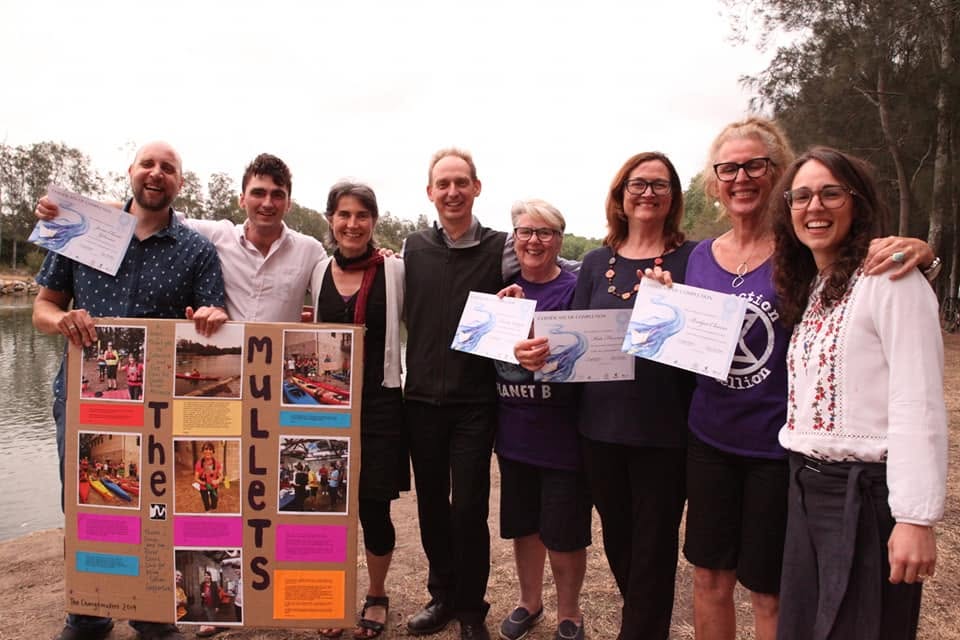

What happens when you bring together people who care deeply about a place — not to tell them what needs fixing, but to discover what they already have and what they might create together?
In 2019, Soulgen founder Dimitrios Papalexis was contracted by the Cooks River Alliance to facilitate a series of workshops for the Cooks River Changemakers Course, drawing on Asset-Based Community Development (ABCD) and participatory approaches.
The Cooks River Alliance brought together Bayside Council, City of Canterbury Bankstown, Inner West Council and Strathfield Council to combine resources, knowledge and relationships in responding to the complex environmental challenges facing the Cooks River.
The river crosses council and community boundaries. So did the opportunity for change.
Starting with place, people and possibility
Aboriginal people have lived along the Cooks River for more than a thousand generations, since time immemorial. Yet urbanisation and other pressures have profoundly affected the health of the river.
The free seven-week Changemakers Course invited people who cared about the Cooks River to explore a different question: how might we use our own skills, knowledge, passions and relationships to work with others and contribute to its future?
At its heart was a simple asset-based belief: within a catchment of more than 550,000 diverse people, everyone has something to contribute.
Participants also went on a field trip with Jennifer Newman, then a lecturer in Aboriginal Studies at the University of Sydney, learning about Aboriginal history and deepening their understanding of the river and the place they were seeking to care for.
Rather than jumping straight to solutions, the journey connected people more deeply with place, story, one another and their own capacity to contribute.
Creating a marketplace for ideas
A key part of the process was creating opportunities for the changemakers themselves to determine what they wanted to explore and act upon.
Using Open Space Technology, we created a marketplace of ideas where participants could put forward possibilities they cared about, gather others around them and begin exploring what they could create together.
The process drew on creative activities, storytelling, theatre, PhotoVoice, guest speakers, prototyping and experiential facilitation.
Instead of beginning with a predetermined list of projects, we began with people’s passions and strengths.
Who cares about this?
Who else wants to help?
What do we already have around us?
Who is already doing something that we can connect with?
And what could we try?
Connecting with the assets already around the river
An ABCD approach also meant looking beyond the people in the program.
The Cooks River was already surrounded by community knowledge, informal networks, environmental groups, local organisations and passionate residents.
Groups such as the Mudcrabs and the Mullets were already contributing to the life and stewardship of the river. The opportunity was not to duplicate what was happening, but to recognise, connect with and build upon the assets already present.
As relationships developed, participants began combining their own gifts and passions with those wider community assets.
This is where ideas started becoming action.
From ideas to prototypes
Through the seven-week journey, changemakers formed strong relationships around a shared purpose and developed a series of practical prototypes.
These included family picnics by the river, scavenger hunts, front-yard blitzes, Mullets kayak clean-ups and full-moon walks.
The prototypes didn’t need to begin as perfectly designed programs.
People could start with what they had, connect with others, try something, learn from the experience and build from there.
That is an important shift in community development: people moving from being consulted or participating in someone else’s program to recognising themselves as contributors and changemakers with the capacity to act.
From individual changemakers to a community
Something equally important was happening beneath the projects.
Relationships were forming.
People who may not otherwise have met were discovering shared passions, exchanging knowledge, finding complementary strengths and building friendships and solidarity across the Cooks River community.
At the final graduation and celebration, Dimitrios was invited to facilitate a session capturing participants’ biggest dreams and visions for the river.
Rather than another conventional evaluation exercise, he brought participants into Circle.
The calling question was:
What is your highest vision for the river and what are you willing to do?
Participants were invited to speak with intention, listen with attention and rely on the wholeness of the group.
The conversation became deeply emotional as people spoke about their relationship with the river, their experience of the program and their hopes for its future.
One participant reflected:
“I usually like to look at things from the Gods, but down here on earth the view is pretty good too.”
What emerged was more than reflection.
There was a stronger commitment to environmental stewardship, community solidarity and healing — and a shared desire to continue what had begun.
When a program becomes a network
One of the most significant outcomes was the formation of the Cooks River Changemakers Network.
The formal course had an end date. The relationships didn’t need to.
The network provided a way for changemakers to remain connected, continue sharing opportunities and support one another to care for and take action around the river.
A video was also created to capture the journey, preserving some of the people, stories, relationships and energy generated through the experience.
What we learned
The Cooks River Changemakers experience reinforced several principles that continue to influence Soulgen’s People & Place work today.
Start with what’s strong, not only what’s wrong.
Environmental and social challenges are real, but communities are not empty places waiting for professionals to bring solutions. They contain people, knowledge, relationships, associations, passions, histories and assets that can become foundations for change.
Connection is an outcome in itself — and an ingredient for action.
The prototypes mattered. But so did the relationships that made those prototypes possible and continued after the formal program ended.
Create conditions for contribution, not just participation.
People weren’t only invited to give their views about what somebody else should do. They were invited to ask what they cared about, what they could contribute and who they could join with to make something happen.
Trust the process — and the people in the room.
Open Space, prototyping, storytelling and Circle provided enough structure to hold the process without determining its outcome. Some of the most powerful moments emerged precisely because there was space for participants to bring their own knowledge, emotion, creativity and leadership.
For us, that’s the heart of asset-based and place-based community development.
Discover what’s strong. Connect what’s there. Create space for possibility. And support people to act together.
The project at a glance
Client: Cooks River Alliance
Partners: Bayside Council, City of Canterbury Bankstown, Inner West Council and Strathfield Council
Soulgen’s role: Contracted facilitator and participatory process design
Program: Seven-week Cooks River Changemakers Course
Approaches: Asset-Based Community Development (ABCD), Open Space Technology, prototyping, storytelling, theatre, PhotoVoice and The Circle Way
Outcomes: Community-led prototypes, strengthened relationships and environmental stewardship, new connections with existing community assets, and the formation of the Cooks River Changemakers Network
Watch the Cooks River Changemakers story
Leave a Reply